Accompanying Measures for Stronger Steels in the Built Environment
 High Strength Steels represent currently the most mature and cost-efficient technology to address the short and medium term GWP and circularity challenges that the steel construction is addressing. However, the uptake has been surprisingly slow.
Structural steels are continuously improving. According to the Worldsteel Association (https://www.worldsteel.org), 75% of the steels that we use today were not available on the market 20 years ago. The production techniques, quenching and tempering and thermomechanical rolling allow nowadays for the economic production of steels with yield strengths between 500 and 700 MPa with the required weldability, fracture toughness and ductility for structural applications. This rapid development brings the demand for structural codes which can benefit from these enhanced properties.
At present, the design of steel structures in HSS (>S460 and up to S700) is performed according to EN 1993- 1-12, Eurocode 3 - Design of steel structures - Part 1-12: Additional rules for the extension of EN 1993 up to steel grades S700. The scope of this part is limited since its recommendations were built on the available knowledge based on experimental tests in the early 2000s. Whenever possible to justify, the existing design rules are applied to HSS as well. Specific rules are available for net cross-section resistance, material toughness and thickness properties, among others.
Conversely, for some cases, EN 1993-1-12:2007 states that other parts of the Eurocode 3 rules are NOT applicable for design in HSS, without giving any alternative rule, such as for angles connected by one leg and other unsymmetrically connected members in tension. For other clauses, Eurocode 3-1-12 does not state if the designer can use the rules already given in the relevant parts of EN1993, neither gives any additional rules. As it is easily understandable, these restrictions set constraints to the application of HSS in practice.
For this reason, since the publication of EN 1993-1-12:2007 in 2007, a lot of research has been carried out related to structural design in HSS, in Europe and around the world. Many of the aspects that were not initially included in Eurocode 3-1-12 are now supported by experimental and numerical studies. This allowed for the increased scope of the new version of Eurocode 3 prEN1993-1-1:202x, where the steel grades in the main text of the code were extended until S700. Therefore, these rules and their application need to be disseminated to allow for broader use of HSS.
Moreover, the incorporation of the steels up to S700 in the main text of Eurocode 3 opened the possibility of introducing a revised scope for the future EN 1993-1-12:202x. Currently, there is a Working Group responsible for the preparation of prEN 1993-1-12:202x that will extend the use of HSS in construction up to S960.
This dissemination project also aims at providing some insight about the design using ultra-high strength steels (UHSS). In the context of STROBE+ project, HSS is defined as rolled steel profiles with a steel grade of S460, welded steel profiles made from plates with steel grade up to S700, and tubes made from steel grades up to S700. UHSS is defined as steel made from plates with a steel grade higher than S700 and up to S960.
Another aspect that limits the use of HSS in practice is the fabrication process, as quite often the workshops do not have the required skills and/or experience in dealing with HSS. This results in additional difficulties when the use of HSS is sought. Currently, there are ongoing developments within CEN TC135 to improve the rules in EN 1090-2 relating to steels S460 up to S960. Aspects related to welding and post-welding treatments were also studied in several European projects (i.e. OPTIBRI, OPTOSTEEL). Recommendations on the execution of HSS structures are needed and would potentially have a significant impact on increasing applications.
Finally, the use of HSS leads to a potential saving of material, by providing higher strength and reduced imperfections. Assessments on the environmental impacts in comparison with conventional steels were done in several projects (OPTIBRI, HILONG, STROBE). According to the most recent assessment, carried out in STROBE, steel weight savings of between 18% and 49% are achievable using HSS, which can be translated into cost savings of up to 14% and embodied carbon savings of between 6% and 45%. Using HSS, it is hence possible to do ‘more with less’ in an environmentally friendly way. Increasing the awareness of this valuable characteristic is very beneficial for the steel sector and society in general. Despite the obvious benefits of HSS, they currently stuck to about the 5% of the market of construction steel.
In order to increase the market share of HSS, a large-scale dissemination exercise like the one that is purpose in STROBE+ project is needed. By spreading all the knowledge acquired in the several research projects in this topic by means of user-friendly tools and clear documentation, will lead consequently, to an increase of the market share of HSS and UHSS in the construction steel sector, because it will, firstly, create awareness about the use of this material in countries where its use is inexistent and, at the same time, an increase of the use of HSS in countries already using it since a good base material and design tools can create a feeling of safety and more confidence among the practitioners using it.
The main aim of the project is the development of valorisation tools for the dissemination of the available knowledge on high-strength steels (HSS) to allow for its wider and more effective use in civil engineering structures. Such tools are not currently available in Europe nor worldwide. The main dissemination will be done through:
1. The publication of a Design Manual for High Strength Steel Structures – the design manual will propose (i) design guidelines and recommendations extracted from literature and recent research outcomes, including RFCS research project, (ii) design examples, and (iii) case studies.
2. The publication of a Guide on the Execution, Sustainability and Economics of High Strength Steel Structures – the contents shall cover the application to civil engineering, best practices from the production to its final application, stressing the sustainability and economics of HSS structures.
3. The development of tools (mobile and web) suitable for everyday practice – one for design and the other for the dissemination of guidelines for Execution, Sustainability and Economics of HSS structures.
4. The development of an online platform to promote the use of HSS in construction, including the feeding of content such as software tools, publications, a photo library of real constructions executed using HSS, videos and streaming of webinars.
5. The organization of Workshops and a series of Webinars to ensure the knowledge transfer to practitioners and, more globally, to strengthen the “HSS” research community in Europe. The preparation of the main deliverables of the project, e.g. the Design Manual and Execution Guide, will be based on recent European and non-European research related to different topics on highstrength steels as well as available normative documents, to propose design methodologies and recommendations which can be used worldwide. Some of the topics that will be covered by these documents are described above.
6. The translation of the disseminations materials from English into 9 other European languages
7. Accelerate the uptake of HSS use in steel construction from the current 5% to 12% after 10 years of the project implementation the following impacts are forecasted:
• 5.57 MTn of CO2/year avoided in 2036 and 27.85 MTn of CO2 2031-2036)
• 4,33 MTn of Steel saved in 2036 and 21,665 MTn of Steel 2031-2036)
• 626 M€/year avoided in 2036 and 3133 M€ (2031-2036)
• 1250 jobs generated in 10 years. New high skilled engineers, welders and others.


STROBE+ is an EU funded project (Grant Agreement Number 101216785 (RFCS-2024) under the Research Fund for Coal and Steel
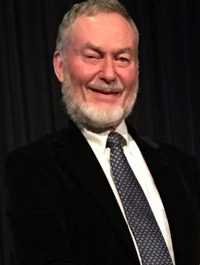 Professor J.M. ROTTER was born in Chesterfield, England and graduated at Cambridge University when he was awarded a Commonwealth Scholarship to study in Australia. He got a PhD in civil engineering from the University of Sydney. His main specialty is the Buckling of Shells.
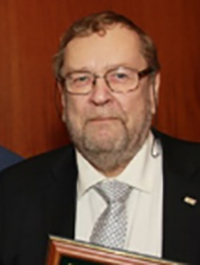 Jouko KOUHI is expert in Connections, welding, stability and fatigue of steel structures. He has been an active member of various ECCS Technical Committees since 1979, working on ENV 1993 part 1.8 from 1999 to 2002.
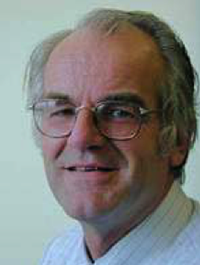 Frans BIJLAARD, Professor of steel structures at the Faculty of Civil Engineering & Geosciences at Delft University of Technology. His main specialties are on stability of steel structures, structural behaviour of joints in steel structures and design of greenhouses.
 The involvement of Professor Jean Pierre MUZEAU in Education and his strong motivation in promoting the use of steel in construction over his career have to be underlined. He has been qualified as “Passeur de Connaissances” (Ndt : conveyor of knowledge) by the Members of the Jury who have underlined his prominent role among the young generations of civil engineers.
 Prof. Joachim LINDNER got a 40-year academic career and extensive experience in civil engineering from lateral torsional buckling through contact splices, historical grey cast iron columns, fatigue behaviour, stability design of glass-beams, scaffolding design, crane girders, plate buckling problems, composite beams and columns, corrugated webs, connection problems and imperfection regulations. He signed around 220 publications.
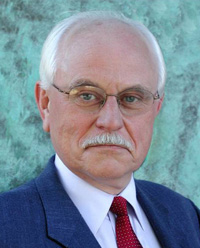 Professor Reidar BJORHOVDE has an impressive academic background, including two Ph.D. in the area of Civil Engineering, and a remarkable professional career which includes several years as a Professor in various universities in North America. He also been the Director of Bjorhovde Group since 1998.
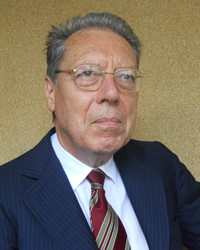 Professor Carlo URBANO has been active on ECCS committee “Stability of steel structures” since 1975. He has been also present on CEN, IABSE, SSRC committees. Graduated at the Politecnico di Milano in 1963, he dedicated his career to the “Strength of Materials”. He developed scientific research mainly on the general theory of elasticity, stability of elastic equilibrium, response to dynamics and elastoplastic vibrations, shell structures, solutions for steel and reinforced structures. Lately, he has focused his works on the elastic and elastoplastic stability of compressed simple or composed steel members in the presence of mechanical and geometrical imperfections and damages due to cyclic actions. He is the author of an incredible number of papers and publications.
 Prof. Ing. Jean-Baptiste SCHLEICH will always be recognised as "Mr Fire” of Europe. He was the leading professor in the development of the "Natural Fire Safety Concept". Under his leadership, the relationship of the fire load to the risk to a structure and its occupants was researched and tested. It is due to his work that structures can now be fire engineered with a significant benefit to the industry, building owners and users.
 Professor Manfred HIRT had been member of the various ECCS Technical Committees. He wrote more than 130 publications as author or co-author. Director of the Steel Structures Laboratory (ICOM) of the Swiss Federal Institute of Technology at Lausanne (EPFL), Prof. Hirt was known on the international scene for his expertise in the field of fatigue and fracture mechanics of steel structures, loads and action on structures, structural safety and serviceability and steel-concrete composite construction. In August 2003, he had been elected President of the International Association for Bridge and Structural Engineering (IABSE).
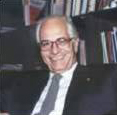 Professor Giulio BALLIO was born in Rome, on 4 March 1940, and graduated in Aeronautical Engineering at the “Politecnico of Milan”, in 1963. He was Ordinario of the Science of Construction at Pavia University and, subsequently, of Construction in Steel at the Politecnico of Milan, where he has also been responsible, since 1985, for the Material Tests Laboratory.
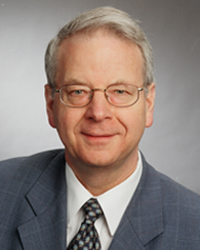 Prof. Dr.-Ing. Gerhard SEDLACEK, was a leading and opinion-forming person in various ECCS technical committees and subcommittees. He was one of the most active person in the European steel research sector as well as in the European codification field. His various activities covered a huge range beginning from intelligent design of steel and composite structures to researching, applying of research results, safety requirements, teaching and training of students and engineers, promotion and developing of steel structures and design tools for a better market share.
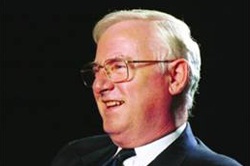 Professor Patrick DOWLING started his working life as an employee of BCSA and subsequently worked both in industry and academia. He was extensively involved with ECCS in plate buckling research and was Chairman of the CEN Eurocode 3 Committee.
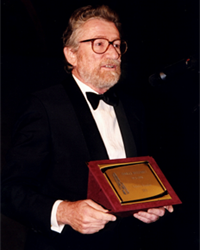 When awarded, Professor Federico MAZZOLANI was Director of the “Institute of Technique of Construction” at the Engineering Faculty of Naples, Italy. Born in Milan, in 1938, and graduated in Civil Engineering at the University of Naples, Prof. Federico M. Mazzolani co-operated since 1970 with ECCS, assuming the responsibility of Committee chairmanship. His activity has been characterised by the issue of several fundamental documents, which played a leader role in the development of the European codification at the level of both national codes and Eurocodes.
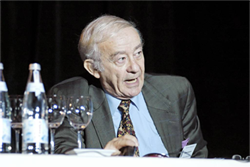 Scientific Manager and Deputy General Manager of the French Technical and Industrial Centre of Steel Construction (CTICM), Professor Jacques BROZZETTI contributed highly to the development of the European Steel Construction. He had a long involvement with various research projects including stability problems, composite construction, fatigue and fire behaviour of steel structures. As a result, he had been involved with many Codes and design guides comprising writing activities. He worked with the profession to promote the steel construction on its various aspects.
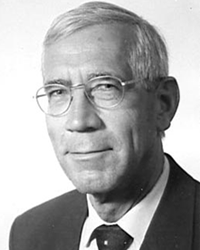 Prof. Jan W.B. STARK, from the University of Delft, The Netherlands, had made substantial contributions to the construction industry in general, and more specifically with regard to steel and composite structures. For many years, he had been an active member of CEN and served ECCS in various committees. The Charles Massonnet Award was presented to him to express our gratitude for his high standard and valuable contribution to the steel construction industry.
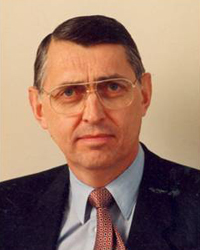 Close collaborator of Professor Charles Massonnet, Professor René MAQUOI, was awarded in recognition of his efforts for the development of steel and composite construction. Indeed, Professor Massonnet was his “master” and conducted his first step in the ECCS activities.
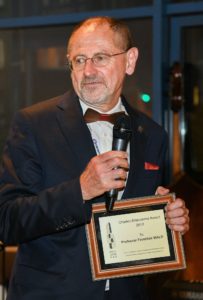 Frantisek Wald concentrates on the connection and fire design of steel structures. He prepared the component model for column bases and the component based finite element model of joints. He works in ECCS Technical Committee 10 - Structural joints and in Project team for preparation of standard - EN 1993-1-8:2020.